Yosuzume: The Night Sparrow That Sings Before Disaster Strikes
Published: March 28, 2026
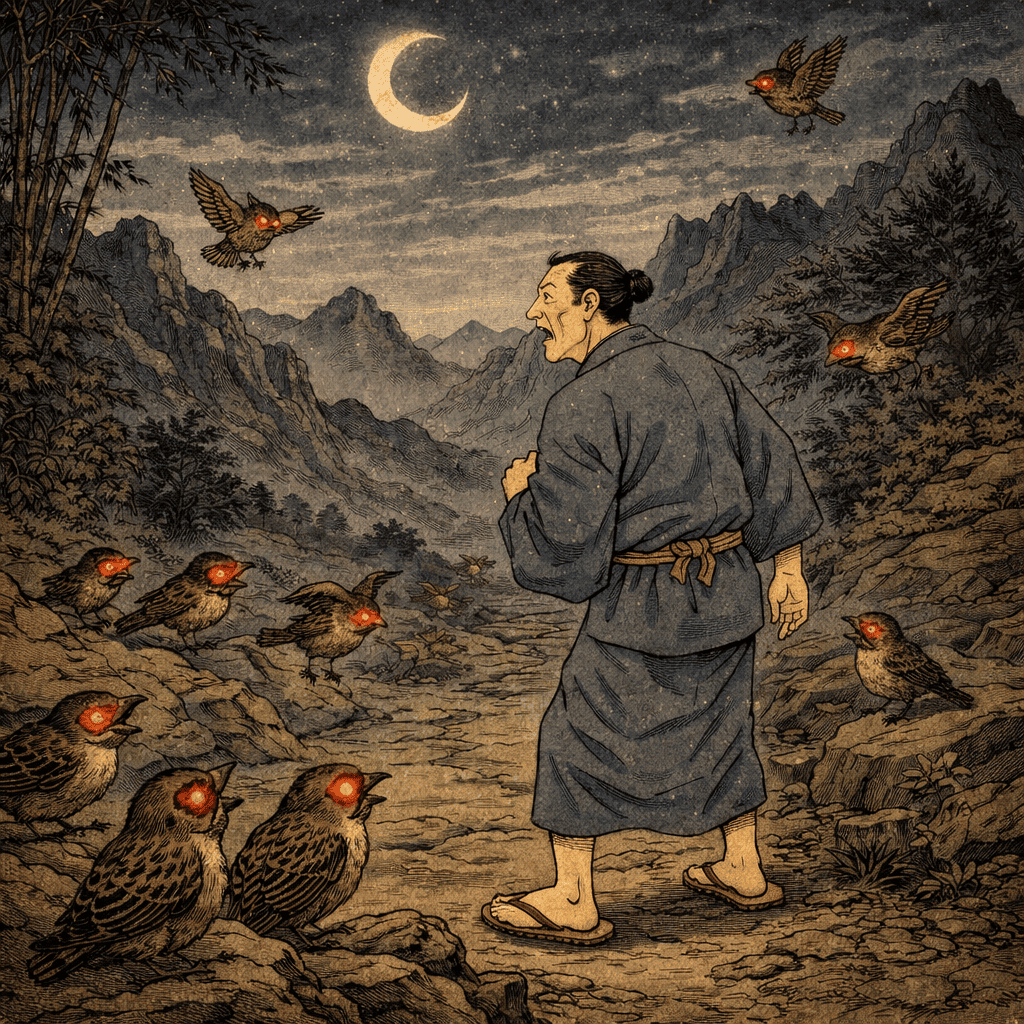
At midnight, in the mountain forests, a sparrow sings. This is wrong in a way that is immediately apparent to anyone who has spent time in nature: sparrows do not sing at night. They are diurnal creatures, roosting with the dark, silent until dawn. A sparrow singing in the deep hours of the night is an event that has no natural explanation. And in the Japanese folk tradition that grew up around this phenomenon, the explanation was never natural: what you are hearing is a warning. Something has gone wrong, or is about to go wrong, in the immediate vicinity. The singing sparrow knows about it. You do not. Not yet.
The yosuzume — "night sparrow" — occupies a distinctive niche in Japanese supernatural tradition: it is not a predator, not a trickster, not a vengeful spirit. It is an oracle, a harbinger, a living signal that something in the environment has crossed out of the ordinary. Its song is not beautiful in the way daylight birdsong is beautiful. It is beautiful in the way that a warning bell is beautiful — precisely because of what it means, and because hearing it means you still have time to act on the information it carries.
What is Yosuzume?
Yosuzume — written 夜雀, literally "night sparrow" — is a supernatural bird yokai that appears as an ordinary sparrow but sings during the night hours, which is understood as an unmistakable sign of impending supernatural danger or disaster. It belongs to the broader category of omen-bearing birds in Japanese supernatural tradition — creatures whose appearance or behavior signals something beyond the natural order. Unlike many yokai that are themselves the source of danger, the yosuzume is better understood as a detector: it senses the presence of malevolent supernatural forces in the area and responds to them with its anomalous nocturnal song.
The tradition holds that travelers who hear a sparrow singing at night should stop immediately, turn back from whatever path they were on, and not continue in the direction the sound came from. The yosuzume's song is a boundary marker, a signal that what lies ahead is not safe for human passage. Whether the danger is a lurking supernatural predator, a site of intense spiritual contamination, or some other form of otherworldly hazard, the yosuzume's song is understood as the reliable signal that ordinary caution is not sufficient and that the traveler's best option is retreat (Michael Dylan Foster, "The Book of Yokai," 2015).
As a concept, the yosuzume represents a category of Japanese supernatural being that Western supernatural traditions largely lack: the benign omen, the warning that comes without malice. It is not trying to harm you. It may not even be aware of you. But its behavior is intelligible to those who know how to read it, and the reading may save your life. The yosuzume's function in folk tradition is partly practical — teaching people to pay attention to anomalous natural behavior — and partly philosophical: a reminder that the natural world contains information that exceeds human understanding and rewards careful, humble attention.
What Does Yosuzume Look Like?
The yosuzume looks like an ordinary sparrow — a small, brown-and-grey bird with the typical sparrow's compact body, short beak, and slightly puffed appearance. The Japanese tree sparrow (Passer montanus), one of Japan's most common birds, is the most likely model for the yosuzume's physical description: a familiar, unremarkable creature that is present in almost every Japanese landscape from urban parks to mountain forests. There is nothing in its physical description to distinguish it from the millions of ordinary sparrows that populate the Japanese countryside.
Its supernatural nature is expressed entirely through behavior rather than appearance: the anomalous timing of its singing, the particular quality of its nighttime song, and the events that invariably follow those who ignore it. This ordinariness is part of what makes the yosuzume so interesting as a supernatural concept — the most mundane of birds, transformed by context alone into a harbinger of the terrible. The yosuzume cannot be identified by looking at it; it can only be identified by when it sings. The supernatural is entirely in the timing.
In the few artistic depictions that exist of the yosuzume, the bird is sometimes shown with a faintly luminous quality — a slight glow around the feathers, or eyes that catch light unusually — that distinguishes it from an ordinary sparrow to the artistic eye even if not to the observer in the dark forest. This visual convention serves the illustrative tradition more than the folk belief itself, which insists on the creature's complete visual ordinariness. What you see is a sparrow. What you hear, at midnight, tells you otherwise.
Where Did Yosuzume Come From?
The yosuzume's origins lie in the ancient Japanese practice of bird divination — tori uranai — the use of bird calls, flight patterns, and anomalous behavior as omens and signs. This practice has deep roots in Japanese culture, pre-dating systematic yokai classification by centuries, and connects to the broader East Asian tradition of understanding birds as intermediaries between the human world and the spirit world. The crane, the owl, the crow, the cuckoo — all carry specific omen significance in Japanese tradition, and the sparrow's nocturnal singing fits into this established interpretive framework.
The specific focus on night singing as an omen reflects the general association of nighttime with supernatural activity and the particular wrongness of behavior that violates natural patterns. In Japanese folk belief, the boundary between day and night is also a boundary between the human world and the supernatural one — creatures that move between these boundaries, or that behave contrary to the patterns appropriate to day or night, are understood to be connected to forces that operate outside ordinary natural law. A diurnal bird singing in the night is precisely this kind of boundary violation.
In some traditions, the yosuzume is specifically connected to the presence of other yokai on mountain roads — it is understood as a creature that exists in a liminal relationship with the supernatural world, sensitive to disturbances that humans cannot detect, and using its song as both a natural response to what it senses and as an inadvertent warning to any humans who happen to be listening. In this interpretation, the yosuzume is not trying to help travelers; it is simply reacting to its environment, and the warning function is a secondary benefit for those who understand what they are hearing. The bird is not a guardian — it is a sensor, and its data is available to anyone with the knowledge to interpret it.
What Are the Most Famous Yosuzume Legends?
The yosuzume appears across regional folk traditions as a warning sign that precedes various supernatural encounters. In numerous Edo Period travel accounts and ghost story collections, the narrative setup includes a traveler hearing a sparrow singing at an unusual hour, either ignoring it — and proceeding to encounter whatever the yosuzume was warning about — or heeding it and surviving to tell the tale. The creature's function as a plot device in these narratives is consistent: it is the moment where the story gives the protagonist a choice, and the moral interest lies in which path they take and what follows from each choice.
The most haunting accounts describe the yosuzume singing persistently — not a brief, anomalous phrase but a sustained, insistent song that continues as the traveler hesitates, as if the bird understands that humans require repeated signals before they override their forward momentum and turn back. The persistence of the song in these accounts makes the bird seem almost desperate — a creature trapped by the limits of its communication, able only to repeat its warning in the only form available to it while a human debates whether the sound is significant.
A related tradition holds that the yosuzume sometimes sings in a way that mimics human voices — not forming words, but producing tones and rhythms that suggest speech rather than birdsong, as if the creature is attempting to communicate something specific that the medium of birdsong cannot carry. This version of the yosuzume legend bridges the omen-bird tradition and the broader category of supernatural mimics, suggesting a being that has been in contact with the human world long enough to absorb its patterns without being able to deploy them effectively.
How Does Yosuzume Appear in Modern Japan?
The yosuzume is a relatively minor figure in modern popular culture compared to yokai with more dramatic visual presences, but it appears in comprehensive yokai collections and has a persistent presence in folklore-focused works set in traditional Japan. Its conceptual resonance — the ordinary thing out of context as omen — has influenced Japanese horror and supernatural fiction more broadly, even when the yosuzume itself is not named. The trope of birds singing at wrong times, or birds falling silent before disaster, appears frequently in Japanese horror as an atmospheric signal to audiences who carry the folk knowledge that such things matter (Michael Dylan Foster, "The Book of Yokai," 2015).
In contemporary Japan, the yosuzume tradition connects to broader cultural currents around environmental awareness and the recognition that the natural world contains information that modern urban life tends to filter out. The image of a bird singing in the night as a signal that something is wrong in the environment has resonance in an era of ecological disruption and climate change; the folk wisdom encoded in the yosuzume legend — pay attention to what the natural world is telling you — has acquired new urgency beyond its supernatural original context.
Which Anime and Manga Feature Yosuzume?
The yosuzume, as a relatively subtle omen-yokai rather than a visually dramatic monster, appears in anime and manga primarily in atmospheric and thematic roles rather than as a central character. Yokai-themed series that work through the traditional Japanese supernatural catalogue — such as Natsume Yuujinchou and GeGeGe no Kitaro — include omen-birds and harbinger creatures in their episodic structures, with the yosuzume tradition informing the broader category of birds-as-supernatural-messengers that appears throughout Japanese folklore-adjacent media.
The broader influence of omen-bird traditions — of which the yosuzume is one of the most distinctively Japanese examples — can be felt throughout the atmospheric construction of supernatural anime and horror anime. Birds singing at inappropriate times, birds behaving strangely, birds that seem to be watching rather than simply present: these visual and auditory cues recur in Japanese animated horror as inherited cultural grammar, drawing on centuries of folk tradition that the yosuzume helps to represent. The creature may not be named, but its logic animates the scenes.
In the tradition of evil or malevolent birds in Japanese supernatural media — a category that includes the tengu, the yamabiko, and various cursed bird-entities — the yosuzume occupies the unusual position of being potentially benevolent: an omen-bird that warns rather than harms. This positions it differently from the more dramatically threatening flying supernatural entities that tend to dominate the action-oriented plots of yokai anime, though its conceptual role as a threshold-marker — announcing the boundary between the safe and the dangerous — is thematically central to the genre in ways that exceed any single depiction (Michael Dylan Foster, "The Book of Yokai," 2015).
Where Can You Encounter Yosuzume in Japan?
Mountain forests throughout Japan provide the yosuzume's natural habitat and its legendary context. The creature is most strongly associated with the mountain regions of central and western Honshu and the forested passes of Shikoku — anywhere that lonely mountain roads pass through dense forest at night, away from the light and noise of human settlement. The specific atmospheric conditions that make the yosuzume's song so powerful in folk tradition — complete darkness, forest silence, the absence of any other human presence — are increasingly rare in modern Japan but can still be found in the mountains.
For those who walk the Shikoku pilgrimage route, night hiking between mountain temples provides the most atmospheric context for understanding why the sound of a bird singing in darkness would have carried such weight for centuries of travelers who passed these same paths before you. The mountain sections of the pilgrimage route — particularly between Temples 12 and 13 in the mountains above Tokushima — pass through exactly the kind of forested, isolated terrain where the yosuzume legend feels not merely historical but immediately present.
The mountains of the Kii Peninsula — the location of many of Japan's most ancient and powerful shrines and temples — offer another landscape deeply saturated with the folk belief traditions that produced the yosuzume. Kumano Kodo pilgrimage trails pass through forest so old and dense that even in daylight it retains a particular quality of threshold — a sense of being on the edge of a world that does not quite observe the ordinary rules. At night, the same forest would be exactly where a bird should not be singing, and would be singing anyway.
Conclusion
The yosuzume teaches the lesson that all omens teach, the lesson that human beings throughout history have been extraordinarily reluctant to learn: when the natural world breaks its own patterns, pay attention. The sparrow does not sing at night. If it is singing, something has changed. The change may not affect you. It may have nothing to do with you. But the possibility that it does — the small, insistent possibility that the song is meant as much for you as for the night itself — is worth taking seriously.
The cost of heeding the warning and turning back is a slight inconvenience. The cost of ignoring it is described in stories that people have been telling each other for centuries, in mountain passes that no longer seem quite as ordinary as they did before the singing started. The bird sings because the night is wrong. Whether you listen is the only choice the tradition offers you — and it is the only choice that matters.
This is The Yokai Files.
Support The Yokai Files
Enjoyed this deep dive into Japanese folklore?
The Yokai Files is reader-supported. Your support helps us research deeper, write more, and keep the darkness alive.