Yuki-onna: The Snow Woman Who Kills with a Kiss
Published: March 27, 2026
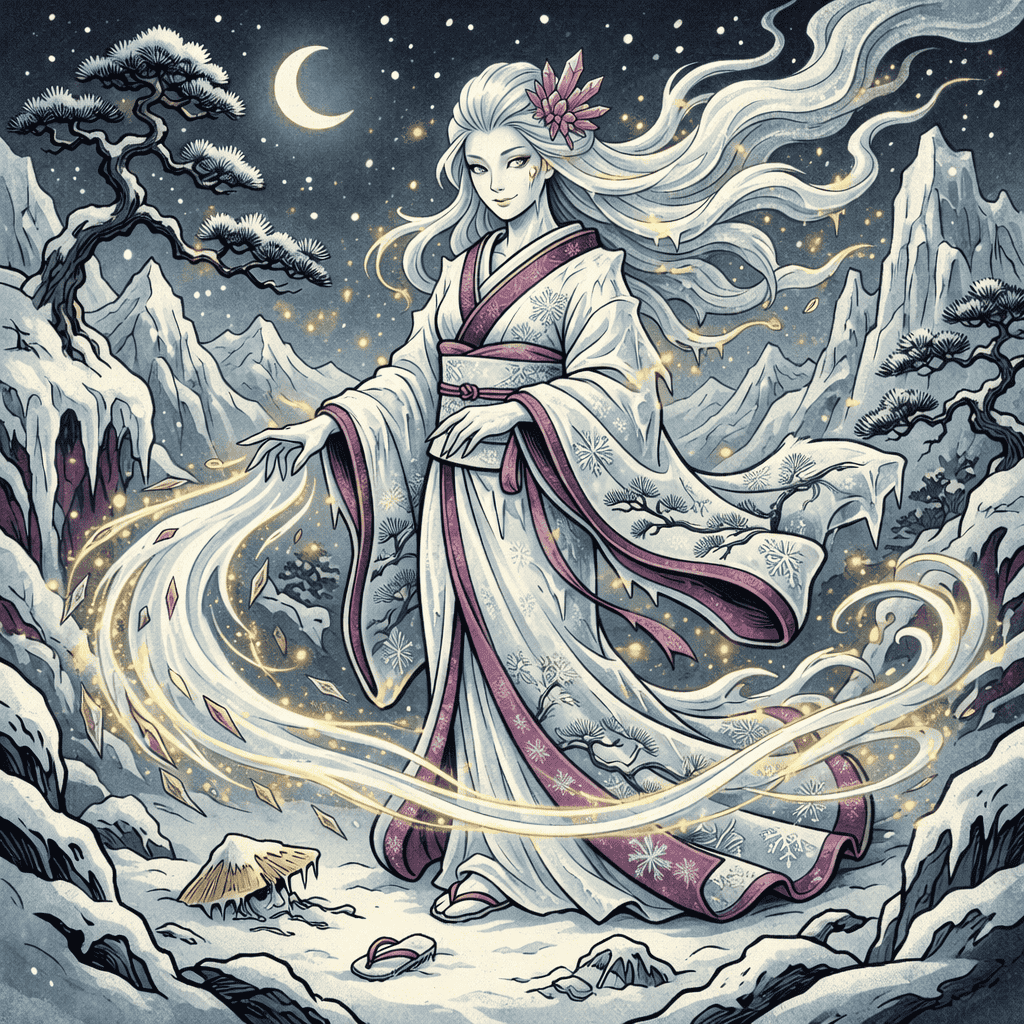
When the mountain passes fill with snow and visibility drops to nothing, when the temperature falls so far below freezing that the trees crack like gunshots in the dark, the traveler who finds themselves lost in the Japanese winter wilderness faces dangers both natural and supernatural. Among the most beautiful and most deadly is the one who comes with the blizzard — pale as fresh snow, hair black as the midnight sky, her breath the vapor that rises from ice-covered lakes in the hour before dawn. She has no need to pursue. She has no need to hurry. She has been here since the mountains themselves were young, and the winter belongs to her entirely.
She does not pursue. She does not need to. She waits with the patience of winter itself, knowing that the cold will bring the lost to her eventually. And in that waiting, she is utterly, devastatingly beautiful — a fact that makes her all the more terrifying. For the Yuki-onna understands something that her victims do not until it is too late: in the deep cold, beauty and death are not opposites. They are the same thing, wearing different faces.
What is Yuki-onna?
Yuki-onna (雪女, literally "Snow Woman") is one of Japan's most iconic and enduring supernatural figures — a spirit of winter who appears in snowstorms and freezing conditions, capable of killing travelers with her icy breath or through more intimate supernatural means, yet also capable of mercy and even genuine love under certain circumstances. She occupies a unique position in Japanese folklore as a figure who embodies both the lethal indifference of nature and a profound, if dangerous, capacity for human emotion that sets her apart from purely destructive yokai (Lafcadio Hearn, "Kwaidan," 1904).
Unlike yokai that are purely malevolent or purely benevolent, Yuki-onna exists in a space of beautiful ambiguity that has fascinated Japanese storytellers for centuries. She is the winter itself — capable of being both the blizzard that kills and the frozen beauty that takes the breath away in an entirely different sense. Her stories are not simple cautionary warnings but complex explorations of human relationships with the natural world, with desire, with the terrible consequences of broken promises, and with the question of whether love can exist between beings whose fundamental natures are incompatible. This moral complexity is what elevates the Yuki-onna above ordinary monster mythology into something approaching tragedy.
Within the broader taxonomy of Japanese supernatural beings, Yuki-onna belongs to a category of nature spirits whose power derives directly from the natural forces they embody. She is not a ghost haunting a specific location, nor a demon pursuing a specific grudge. She is elemental — winter given consciousness and will, a being whose very existence is inseparable from the season that created her. When the snow melts, she withdraws. When winter returns, she is there again, unchanged, patient, and eternally beautiful (Michael Dylan Foster, "The Book of Yokai," 2015).
What Does Yuki-onna Look Like?
Yuki-onna is described with extraordinary consistency across centuries of Japanese folklore, across regional variations that span the full length of the Japanese islands from Kyushu to Hokkaido. She is always a woman of supernatural beauty: chalk-white skin that makes her nearly invisible against the snow, long black hair that streams behind her in the winter wind like a banner of night sky, and eyes of pale blue or silver that hold no warmth whatsoever. This color contrast — the absolute white of her skin against the absolute black of her hair — is itself a visual representation of the winter landscape, the snow-covered earth against the bare, dark trees. She is not merely in the winter; she is the winter, made visible in a form the human eye can perceive.
She is tall — taller than ordinary women — and moves with a preternatural grace that no human could replicate. She glides across snow without leaving footprints, a detail that appears in accounts from every region of Japan and serves as the surest sign of her supernatural nature. She appears and disappears with the sudden quality of a blizzard's gusting winds — there in an instant, gone in the next, leaving only disturbed snow and a cold that seems to linger longer than it should. Her breath is visible as vapor even in temperatures that should not produce condensation, and where she exhales, frost forms on surfaces and exposed skin. Regional traditions add variations to this core image: some accounts describe her wearing a white kimono of exquisite quality, others describe her wearing nothing at all, utterly immune to the cold that is destroying everything around her (Toriyama Sekien, "Gazu Hyakki Yako," 1776).
When she chooses to kill, she either breathes her deathly cold directly into a victim's face — draining their life force and replacing the warmth in their blood with something that is not quite ice but functions exactly as ice does — or she simply embraces them, holding them against her snow-cold body until the cold has done its work. The killing is almost gentle. This is perhaps the most disturbing element of all the accounts: Yuki-onna does not kill with violence. She kills with cold, which in its final stages is indistinguishable from sleep.
Where Did Yuki-onna Come From?
The earliest written accounts of Yuki-onna appear in the Sōgi Shokoku Monogatari, a collection of tales from the late fifteenth century compiled by the renga poet Sogi. However, her presence in oral tradition is almost certainly far older, rooted in the very real and ever-present dangers that Japanese mountain winters posed to travelers and rural communities throughout the archipelago's history. Japan's mountain geography is severe — passes that are merely challenging in summer become life-threatening in winter, and before the modern era, being caught in a mountain snowstorm often meant death. This was not a rare occurrence but a regular feature of winter life in the snow country (yukiguni) regions of central and northern Honshu, where snowfall regularly exceeds levels that would be considered catastrophic in most other parts of the world.
This quality of hypothermia — the way it seduces the dying with feelings of warmth and even euphoria in its terminal stages — maps directly onto the Yuki-onna's method of killing. In the advanced stages of hypothermia, victims report feeling warm, may remove their clothing, and often experience a profound sense of peace and well-being just before death. She is beautiful, she is compelling, and surrendering to her feels not like death but like rest. The folklore appears to encode a practical survival lesson in supernatural narrative form: the beauty of winter landscapes conceals lethal danger, and the comfortable, seductive feelings of late-stage hypothermia are not salvation but the prelude to death (Shigeru Mizuki, "Yokai Daizukan," 1994).
Regional variations in Yuki-onna traditions reveal the different relationships that different communities had with winter. In the heavy snow country of Niigata and Toyama, where winter was an annual life-or-death reality, Yuki-onna accounts tend toward the more terrifying — she kills readily and mercilessly, a winter that cannot be reasoned with. In warmer regions where snow was less familiar and more exotic, she appears more frequently as a figure of romance and tragedy, her danger balanced by genuine pathos. These regional differences suggest that the Yuki-onna mythology was not invented in one place and spread outward but arose independently in multiple locations, each community constructing their own supernatural explanation for the specific form that winter danger took in their geography.
What Are the Most Famous Yuki-onna Legends?
The most celebrated Yuki-onna story was recorded by Lafcadio Hearn in his 1904 collection Kwaidan, based on a tale told to him by his Japanese wife Koizumi Setsu, who had heard it in the Musashi province. In it, two woodcutters — an older man named Mosaku and his young apprentice Minokichi — are caught in a blizzard and take shelter in a ferryman's hut. In the night, Yuki-onna appears, entering without opening the door, moving through the sealed hut as easily as wind moves through a keyhole. She breathes her killing cold onto the sleeping Mosaku, freezing him to death instantaneously. She turns to the young Minokichi, preparing to do the same — then hesitates, struck by his youth and beauty. She spares him on the absolute condition that he never speak of what he has witnessed to anyone. If he breaks this vow, she will find him wherever he is and kill him without mercy (Lafcadio Hearn, "Kwaidan," 1904).
Years pass. Minokichi marries a beautiful woman named Oyuki who has appeared from nowhere — unusually pale, unusually graceful, with eyes that seem to hold winter in their depths. They have children and live happily for years, her warmth as a wife and mother apparently genuine, the winter nature that she carries inside her carefully concealed. One winter evening, watching the snow fall with the quiet intimacy of long-married people, Minokichi makes the catastrophic error of telling his wife the story of what happened to him that night in the blizzard — describing the beautiful woman who appeared from nowhere and spared him. His wife's eyes go cold. She reveals herself as the Yuki-onna. She reminds him of his vow. She tells him she will not kill him only because of their children, who carry her blood — but if he ever speaks of it again, she will return without mercy. Then she dissolves into the winter air, never to return, leaving him with children who sometimes leave no footprints in the snow.
Other regional legends tell different aspects of the Yuki-onna's nature. Some accounts describe her appearing before lost travelers and offering them shelter — leading them to what appears to be warmth and safety, only for the traveler to be found frozen in an open field come morning. Others describe her as genuinely compassionate toward certain individuals, particularly young children separated from their parents in snowstorms, whom she guides to safety before disappearing. These contradictory accounts are not inconsistencies but accurate reflections of winter itself — unpredictable, indifferent to human intentions, capable of sparing one person while destroying another by mechanisms that appear entirely arbitrary.
How Does Yuki-onna Appear in Modern Japan?
Yuki-onna is among the most frequently depicted yokai in modern Japanese media, appearing in countless anime, manga, video games, and films across more than a century of Japanese popular culture. Her combination of lethal power and melancholy beauty makes her a compelling figure for storytellers exploring themes of impossible love, the boundary between human and supernatural, and the hidden dangers concealed within natural beauty. The Kwaidan (1964) film by director Masaki Kobayashi adapted the Hearn story with extraordinary visual power, creating one of cinema's most haunting supernatural images in its depiction of Yuki-onna — a film that remains a touchstone for Japanese horror aesthetics.
In video games, Yuki-onna appears across numerous titles as both enemy and character — from traditional Japanese horror games to fantasy role-playing games that draw on the full breadth of Japanese supernatural tradition. The Touhou Project series features her prominently as Letty Whiterock, a winter spirit whose characterization draws directly from folklore. Western audiences may recognize Yuki-onna archetypes in figures like the Snow Queen from Scandinavian tradition — the beautiful, cold, all-powerful winter spirit who can kill with her touch — suggesting a universal human tendency to imagine winter's lethal beauty as a conscious, feminine presence.
Which Anime and Manga Feature Yuki-onna?
The Yuki-onna has been directly adapted and referenced in anime and manga with remarkable frequency, her combination of supernatural beauty and lethal cold making her a natural protagonist for stories about impossible love and the boundary between the human and supernatural worlds. One of the most direct and beloved adaptations appears in Nurarihyon no Mago (Nura: Rise of the Yokai Clan), where Tsurara Oikawa is a Yuki-onna who serves as a loyal member of the Nura yokai clan — a portrayal that preserves the traditional visual characteristics of the Yuki-onna while giving her a fully realized personality and emotional depth beyond the archetype.
In Rosario + Vampire, the character Mizore Shirayuki is explicitly a Yuki-onna whose cold powers and complex emotional life — she is painfully shy and deeply lonely, her ice abilities a direct expression of her interior isolation — represent a thoughtful engagement with the Yuki-onna archetype. These two characters illustrate how anime has approached the Yuki-onna tradition: not as a simple monster to be defeated but as a figure whose supernatural nature reflects specific human psychological states, whose cold power is an externalization of interior experience. This approach honors the ambiguity that has always been central to the Yuki-onna mythology — she is dangerous precisely because she is real, because the cold she embodies is not mere malice but something far more complex.
Where Can You Encounter Yuki-onna in Japan?
The mountain passes and deep valleys of Niigata Prefecture, in Japan's celebrated snow country (yukiguni), represent the heartland of Yuki-onna tradition. This region receives some of the heaviest annual snowfall in the world outside of polar regions — several meters in an average winter, with exceptional years seeing depths that bury single-story buildings entirely. The combination of extreme weather, remote mountain terrain, long winters that isolate communities for months at a time, and deep folkloric tradition creates an atmosphere in which the Yuki-onna story does not feel like ancient superstition but like a genuine and reasonable explanation for specific local dangers. The town of Tokamachi and the broader Uonuma region maintain cultural traditions centered on snow and its supernatural dimensions that keep the Yuki-onna legend alive in living practice rather than merely historical record.
The Japanese Alps — particularly the high passes between Nagano and Gifu Prefectures, including the historically significant Nakasendo routes — carry Yuki-onna associations in local folklore that date back centuries of mountain travel. Mountain villages throughout Tohoku and Hokkaido maintain their own regional variants of the snow woman legend, each adapted to the specific geography and historical experience of the community. In Aomori Prefecture, whose Towada-Hachimantai National Park experiences some of the most dramatic winter conditions in Japan, the Yuki-onna tradition merges with local mountain spirit beliefs to create accounts that are more elemental and less narratively structured than the Kwaidan version — raw expressions of winter's power rather than stories of broken promises. In all these places, when the snow comes heavily and visibility drops and the silence of the blizzard becomes absolute, the old stories feel less like folklore and more like accurate descriptions of something that is actually happening, just outside the circle of firelight.
Conclusion
Yuki-onna endures because she embodies something fundamentally true about the winter world — that its beauty is inseparable from its danger, and that the most deadly things often come in the most beautiful forms. She is neither a monster to be defeated nor a spirit to be appeased with offerings and rituals. She is winter itself given consciousness and will, with all of winter's contradiction: the silence of heavy snowfall and the violence of the blizzard that follows in its wake, the crystalline beauty of ice formations and the death that comes from prolonged contact with them. Her stories teach this truth not through abstraction but through narrative — through the specific horror of a young man watching the woman he loves reveal herself as the spirit that killed his master, through the specific loneliness of a supernatural being who chose love and then had it destroyed by human weakness.
In the deep snows of Japan's mountains, when the wind sounds almost like a woman's voice and the cold seeps into your bones with a strange, sweet heaviness that makes sleep seem appealing, remember her. Remember that the most dangerous moment is the one when the cold stops hurting and starts feeling like warmth. That is her breath, and she is patient, and she has all winter to wait for you to close your eyes.
This is The Yokai Files.
Support The Yokai Files
Enjoyed this deep dive into Japanese folklore?
The Yokai Files is reader-supported. Your support helps us research deeper, write more, and keep the darkness alive.