Zashiki-warashi: The Child Spirit Whose Presence Brings Fortune and Whose Departure Brings Ruin
Published: March 28, 2026
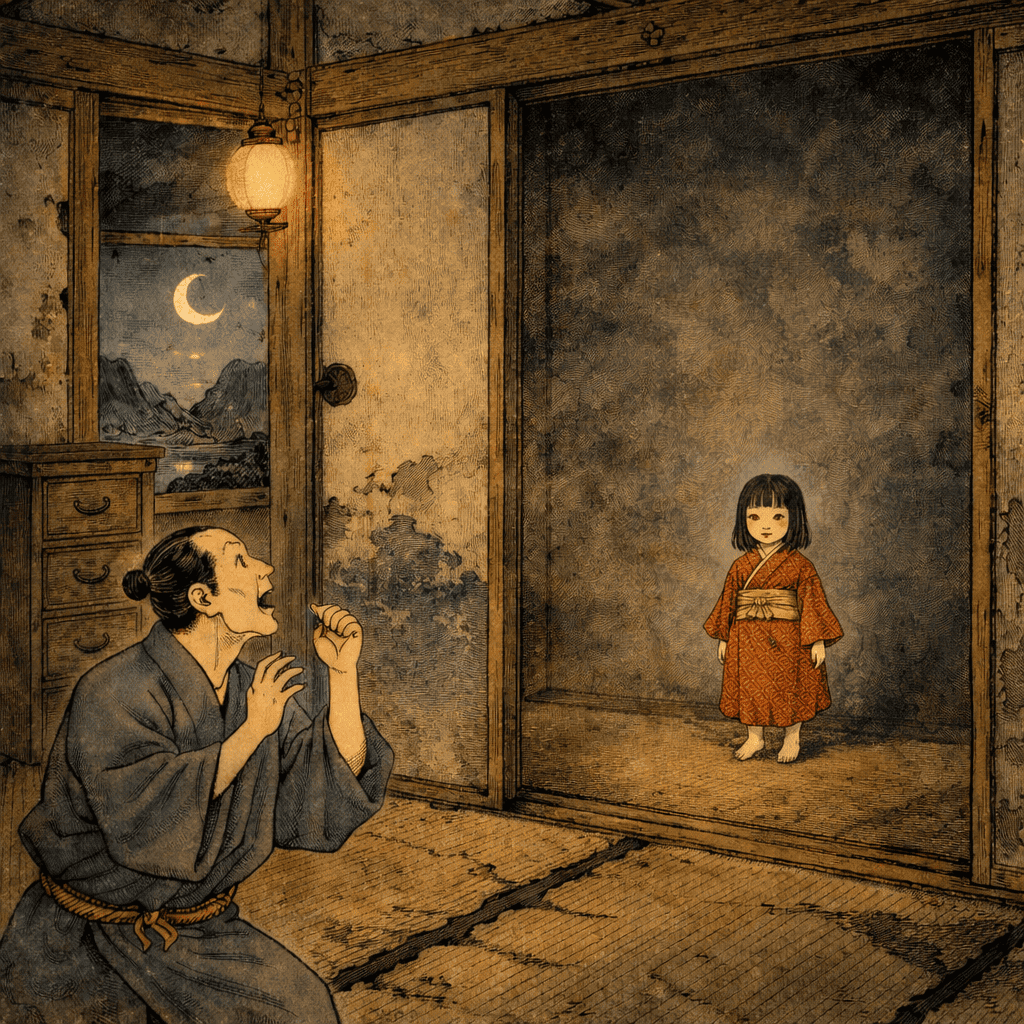
The house has been in the family for six generations. It is large, old, and slightly too quiet in the specific way that old houses are — not the silence of emptiness, but the silence of something listening. Sometimes, very late at night, you hear the sound of children playing in the zashiki — the formal tatami sitting room that is never used, kept clean and ready for guests who never come to formal rooms anymore. When you investigate, the room is empty, the cushions arranged exactly as you left them, the tatami undisturbed. In the morning, sometimes, there are small footprints in the dust of the hallway, tracking a path from nowhere back to nowhere. The old members of the family smile gently when you bring this up. They say it is a good sign. They say it means the house has been chosen. They say you should be grateful — very grateful, more than you understand yet — that it has decided to stay.
Because the day it chooses to leave — the day the footprints are gone and the playing stops and the zashiki falls silent in a different, emptier way than before — that is the day the family's fortune ends. That is when the decline begins: when the business loses clients, when the harvest fails, when the members of the household start falling ill in ways that doctors cannot explain, when everything that has been built across generations begins to quietly, inexorably unravel. The zashiki-warashi giveth. The zashiki-warashi taketh away. And it will not tell you when it is going.
What is Zashiki-warashi?
Zashiki-warashi — "zashiki child" or "parlor child" — is a household spirit from the Tohoku region of northeastern Japan, particularly strongly associated with Iwate Prefecture, where belief in the creature is most densely documented and most thoroughly integrated into local folk practice. The name refers to the zashiki, the formal tatami-floored sitting room found in traditional Japanese houses, which is where the spirit is said to prefer to dwell — rooms kept clean and rarely used, spaces that hold a certain kind of preserved quiet. It manifests as the presence of a child — typically perceived as between five and twelve years old, dressed in traditional children's clothing with hair in an old style — who inhabits the household, plays quietly and sometimes noisily, and brings good fortune to the family as long as it remains.
The zashiki-warashi is unusual among yokai in being almost entirely benevolent in its direct effects while carrying a profound implicit threat. It does nothing harmful while it is present — it plays, makes noise, sometimes moves objects or sleeps in beds or pulls off sleeping people's blankets with a childlike mischief that is alarming only in its inexplicability. Its presence means prosperity: businesses associated with households that have a zashiki-warashi prosper; families with the spirit thrive across generations. Its absence means ruin: not through any action the spirit takes on departure, but through the withdrawal of whatever it provided simply by being there. To have a zashiki-warashi is to become dependent on its goodwill in a way that cannot be managed or guaranteed. And no spirit's goodwill can be assumed to last forever (Michael Dylan Foster, "The Book of Yokai," 2015).
What Does Zashiki-warashi Look Like?
Accounts of the zashiki-warashi's appearance are remarkably consistent across generations of witnesses in Iwate Prefecture — the kind of consistency that either indicates a genuine shared perceptual experience or a particularly stable and precisely transmitted folkloric tradition. The spirit appears as a child of around five to twelve years old, most commonly described as a girl with a round, red-cheeked face, wearing a red kimono or traditional children's dress, with her hair arranged in the old style appropriate to her apparent age. She is typically seen only at the very edge of vision — caught in the corner of the eye and gone when you turn to look directly, as though her visibility depends on not being looked at too carefully. Or she is glimpsed in the moment between waking and sleep, sitting quietly in the corner of a dark room, apparently watching with an attention that is benign but absolute.
The sounds of the zashiki-warashi — small running footsteps, the light sound of a child playing, occasional voices without words — are often heard when the spirit itself is not seen. In many accounts, the sound is the primary manifestation: you hear the child before you can see it, and the sound continues regardless of whether the seeing ever comes. Some traditions describe the zashiki-warashi as being visible only to children and to certain spiritually sensitive adults, with most household members experiencing only indirect evidence — the moved objects, the sounds, the footprints — without ever seeing the spirit directly.
Where Did Zashiki-warashi Come From?
The origins of the zashiki-warashi legend are deeply rooted in the specific history of the Tohoku region, where the tradition is strongest and most elaborated. Several scholarly theories exist about what the spirit actually represents at its historical foundation. The most widely accepted scholarly explanation connects the zashiki-warashi to the historical practice of mabiki — infanticide practiced in times of famine or extreme poverty, which was tragically common in Tohoku during the repeated crop failures and famines of the Edo period and earlier. Children killed in this way were sometimes buried within the house walls or under the floor of the main room, and the spirit that subsequently appeared in the household was understood to be the ghost of the child, whose relationship with its family had not ended with its death.
This interpretation gives the zashiki-warashi legend a dimension of historical tragedy that coexists with, and in some ways deepens, the cheerful surface of the tradition. The playful child spirit that brings fortune to prosperous households is also, in this reading, the ghost of a child who was denied life — its ongoing presence in the household a form of haunting that has been culturally transformed into blessing through the mechanisms of folk religion and ancestor veneration. The prosperity it brings is understood, in this light, as a form of reciprocity: the family that honors and maintains a relationship with the spirit of the child it killed receives fortune as a form of supernatural reconciliation. The laughter in the empty room carries a different weight when you know this history.
What Are the Most Famous Zashiki-warashi Legends?
The zashiki-warashi entered national literary consciousness through Kunio Yanagita's 1910 collection Tono Monogatari — The Legends of Tono — which documented the folklore of the Tono region of Iwate Prefecture with extraordinary precision and sympathy. Yanagita was among the founders of Japanese folklore studies as an academic discipline, and his treatment of the zashiki-warashi took it seriously as a genuine expression of folk belief rather than mere superstition. He recorded multiple accounts of specific households with resident spirits, describing the prosperity of families that had the spirits and the ruination of families from which the spirits had departed, and his documentary approach gave the tradition a credibility and national audience that purely local folklore could not have achieved.
One of the most widely cited modern zashiki-warashi events occurred in 2009, when the Ryugenji Mabechi Ryokan in Hanamaki, Iwate Prefecture — a traditional inn that had become famous as a destination for travelers hoping to encounter its resident zashiki-warashi — was destroyed by fire. The fire occurred in circumstances that local commentators connected to the inn's owners having sold a particular room known to be inhabited by the spirit. The interpretation widely circulated was that the spirit, having been treated as property rather than as a guest, expressed its displeasure in the most final way available. The inn had been operating as a zashiki-warashi experience destination, and the story of the fire spread throughout Japan as what appeared to many to be a direct confirmation of the tradition's warning: the spirit is not yours to sell.
How Does Zashiki-warashi Appear in Modern Japan?
The zashiki-warashi has become one of the most beloved child spirits in modern Japanese popular culture, appearing in anime, manga, games, and literature with a frequency and affection that reflects its strong emotional resonance. The figure of a small child who brings fortune but cannot be commanded, who plays in empty rooms and whose departure signals catastrophe, has proven endlessly generative for storytellers interested in the intersection of the domestic and the supernatural, the beloved and the uncontrollable.
Which Anime and Manga Feature Zashiki-warashi?
Natsume's Book of Friends (Brain's Base, 2008) — one of the most critically and commercially successful supernatural anime series of the 2000s — features a zashiki-warashi as a significant recurring character. The series' general approach to yokai, which emphasizes their emotional complexity and their relationships with humans rather than their danger, made the zashiki-warashi a natural subject: a being defined entirely by relationship, by presence and absence, by the fortune it brings and the grief its departure causes. In the series, the zashiki-warashi is depicted with the traditional appearance — a child in old-fashioned clothing — but given a personality that makes the traditional themes of impermanence and attachment feel immediate and personal. The series as a whole draws deeply on Tohoku folk tradition, and its treatment of the zashiki-warashi is among its most faithful folkloric engagements.
Zashiki-warashi no Tatami-chan (2020) takes a thoroughly modern and comedic approach to the tradition: a zashiki-warashi who has followed a family when they moved from a traditional house to a modern apartment building in Tokyo, now attempting to navigate twenty-first-century urban life while maintaining her traditional identity. The anime is gentle and charming, playing the spirit's encounters with contemporary conveniences — smartphones, convenience stores, the subway — for humor, but its premise is built on genuine folkloric understanding: the zashiki-warashi's connection to place, the question of what happens to traditional household spirits when the traditional household no longer exists, and the persistence of old bonds across new circumstances. It represents the yokai domestication process at its most cheerfully self-aware.
Where Can You Encounter Zashiki-warashi in Japan?
Tono City in Iwate Prefecture is the epicenter of zashiki-warashi tradition and the most rewarding destination for anyone interested in the creature's folkloric roots. The Tono Furusato Village preserves traditional L-shaped (magariya) farmhouses of the kind in which zashiki-warashi were most commonly reported, and the atmosphere of these preserved houses — large, dark, smelling of old wood and tatami, with the formal rooms exactly as they would have been — makes it easy to understand why a child spirit might choose such spaces to inhabit. The Tono Monogatari Museum, dedicated to the folklore that Kunio Yanagita documented in 1910, provides context for the zashiki-warashi tradition within the broader folk culture of the region.
Several traditional inns and old farmhouses in the Tono region and broader Iwate Prefecture claim resident zashiki-warashi, and some offer accommodation specifically designed around the possibility of a spirit encounter — rooms kept in traditional style, no modern technology that might disturb the atmosphere, and the expectation that guests who come in the right spirit may hear small footsteps in the night. Whether or not the spirit appears, the experience of sleeping in a traditional Japanese farmhouse in the deep countryside of Tohoku is itself something that belongs to a different world than the one most visitors arrive from.
Conclusion
The zashiki-warashi is the most tender and most melancholy of Japan's household spirits — and perhaps the most honest about the nature of good fortune itself. It embodies the uncomfortable truth that prosperity is never entirely your own work, that what you have built rests on foundations you did not lay, and that what sustains you may one day simply choose to leave. The child who plays in the empty room is a child who cannot grow up, bound to a house that changes around it across generations, outlasting every member of the family that adopted it. Its fortune-bringing is real, but so is its impermanence. No spirit stays forever, and every zashiki-warashi will eventually depart — not necessarily because of anything done wrong, but because departure is the nature of all things that bring joy, and the tradition is honest enough to say so clearly. The sound of small feet in an empty room is one of the most haunting things in Japanese folklore, because it means something wonderful is here right now. And wonderful things are always leaving.
This is The Yokai Files.
Support The Yokai Files
Enjoyed this deep dive into Japanese folklore?
The Yokai Files is reader-supported. Your support helps us research deeper, write more, and keep the darkness alive.