What Is a Hebigami? The Snake Gods Behind Mononoke’s Final Chapter
Published: September 16, 2026
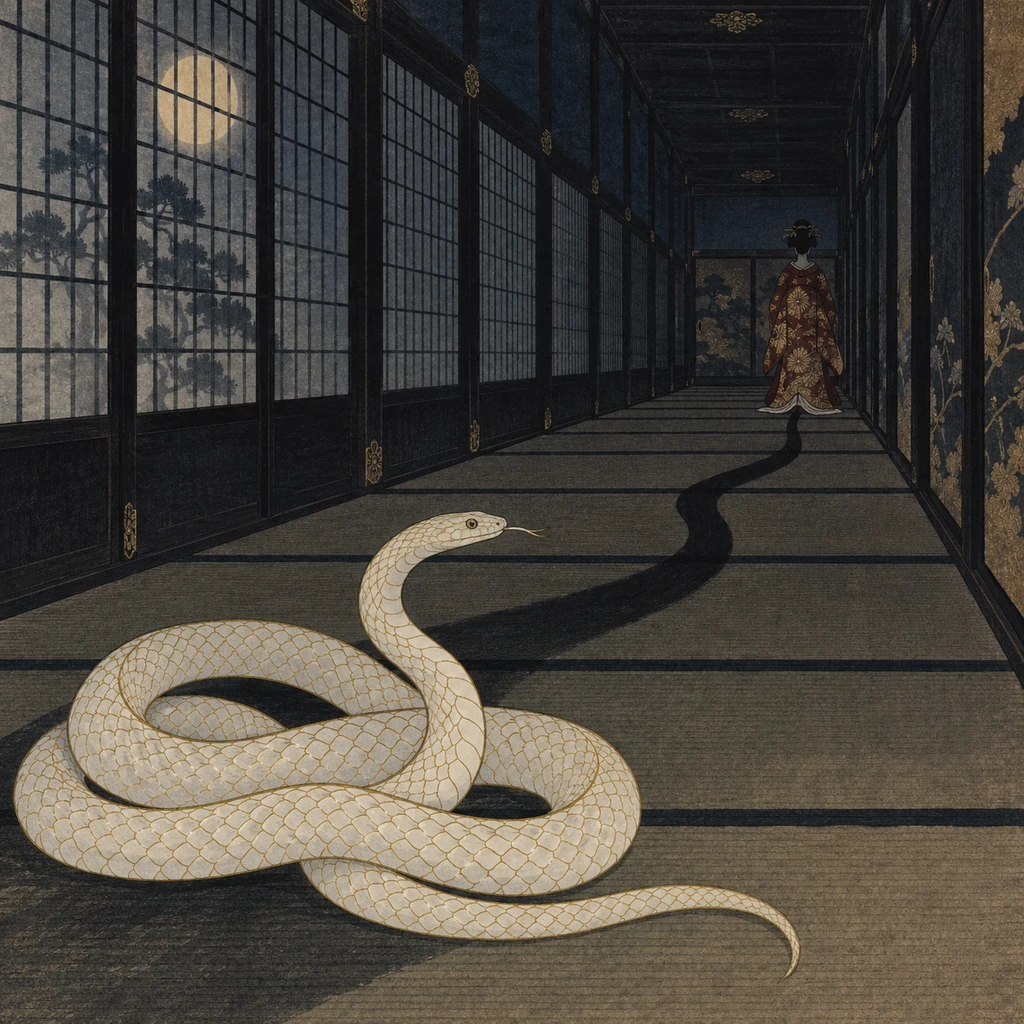
An original illustration made for this article — not a still from the film, and not a depiction of any particular shrine. The white snake, the trailing shadow and the woman walking away are the three pieces of the Japanese serpent tradition this article is about.
The Word Originally Meant an Illness
In English, mononoke has become a word for a monster. Something with a shape, which can be pointed at, and which a sword can be put through.
That is not what the word meant when it first appears in writing. The oldest surviving use that Japanese reference works cite is in the Nihon Kōki, the court chronicle, in an entry for the intercalary twelfth month of the seventh year of Tenchō — 830 CE. Five monks were summoned to recite the Diamond Sutra, and the Bureau of Divinities was ordered to perform a purification. The purpose, the entry says, was to make apology to the mononoke.
Not to kill it. To apologise to it.
The word is built from two pieces, and both of them are strange to a modern reader. Mono in the old language covered demons, spirits, the rough aspect of a divine soul, and more generally a presence that is sensed without being seen. Ke meant sickness — the Taihō Code writes epidemic disease as toki no ke, the sickness of the season. Put together, mononoke named neither the spirit nor the monster but the third thing: the illness that a presence causes. It was a diagnosis before it was ever a creature.
Keep that in the back of your mind for the next twenty minutes, because it explains the entire structure of the anime series that borrowed the word, and it explains why a story about a snake god is set in a building full of women who cannot leave.
Not Princess Mononoke
Before anything else, the disambiguation, because a very large number of people arrive at this subject by accident.
Mononoke is not Princess Mononoke. They share a word and nothing else. Hayao Miyazaki’s 1997 film is a Studio Ghibli feature about a girl raised by wolves and a forest at war with an ironworks; if that is what you were looking for, we have written about the real folklore behind the spirits in Princess Mononoke separately.
Mononoke without the princess is a 2007 television series made at Toei Animation, directed by Kenji Nakamura, broadcast on Fuji TV’s noitaminA block between July and September of that year. It is twelve episodes long, it looks like nothing else in animation, and it is now the origin point of a film trilogy that finishes this month.
What Lands on Netflix on 29 September
Mononoke the Movie: Chapter III — The Curse of the Serpent — in Japanese Gekijōban Mononoke Dai-San-Shō: Hebigami, which is simply Snake God — opened in Japanese cinemas on 29 May 2026 and arrives worldwide on Netflix on 29 September 2026. It runs 87 minutes. Kenji Nakamura is general director, Tomoaki Koshida directs, Studio Kafka and EOTA animate, Twin Engine distributes, and Hiroshi Kamiya returns as the Medicine Seller.
It is the last of three. The pattern of the releases is worth setting out, because it is the reason this trilogy has an English-speaking audience at all.
| Film | Subtitle | Japan | Netflix, worldwide |
|---|---|---|---|
| Chapter I | Phantom in the Rain (唐傘 Karakasa) | 26 Jul 2024 | 28 Nov 2024 |
| Chapter II | The Ashes of Rage (火鼠 Hinezumi) | 14 Mar 2025 | 14 Aug 2025 |
| Chapter III | The Curse of the Serpent (蛇神 Hebigami) | 29 May 2026 | 29 Sep 2026 |
Four to five months, every time, between a limited arthouse run in Japan and a simultaneous release in every country Netflix operates in. In Japan these are modest films: Chapter III opened at number six, taking about 117 million yen across its first three days, which is a respectable result for a stylised feature that was never built to compete with blockbusters. Outside Japan, the streaming date is effectively the release date, and it is the only one most viewers will ever notice.
What happened after those streaming dates is the part worth knowing before you press play. Phantom in the Rain took a bronze audience award for Best Animated Feature at the Fantasia International Film Festival in Montreal in 2024. The Ashes of Rage did it again at the twenty-ninth Fantasia in 2025 — two consecutive years of an audience, not a jury, voting for it. Richard Eisenbeis at Anime News Network graded Phantom in the Rain an A, and made the point that the film would be worth watching for its mystery and its themes even if you stripped the visuals away, which for this series is a genuine compliment.
The visuals are, in fairness, most of the conversation. The trilogy inherits the television series’ refusal to draw anything in a normal way: surfaces are printed with textile and paper grain, colour is laid in flat washes that behave like dyed cloth, and rooms slide apart like screens instead of cutting. It is the closest animation has come to looking like a woodblock print that has been left out in the weather.
And it is not the end of the franchise, despite being the end of the trilogy. In July 2026 a new Mononoke project was announced, introducing a third Medicine Seller — Ken (乾), joining Ri (離) of the television series and Kon (坤) of the films — with a set of three original novels from Kadokawa, one for each. Whatever Chapter III closes, it is not the door.
The Five Mononoke That Started It
The 2007 series is built from five self-contained cases, and each one is named for the thing at the centre of it. They are not connected. The only recurring element is the man who walks into each of them: a nameless travelling medicine seller with a box of remedies on his back and a sword he is not allowed to draw.
That restriction is the engine of the whole thing. The Medicine Seller cannot unseal his blade until he knows three things about the mononoke in front of him — its Katachi, its Form; its Makoto, its Truth, meaning where it came from; and its Kotowari, its Reason, meaning what it wants. In practice this means every episode is an interrogation of the living rather than a fight with the dead. The monster is rarely the problem. The monster is the symptom, and somebody in the room is the cause.
Which is, if you have been keeping that first section in mind, exactly what the word mononoke meant in 830.
| Arc | Episodes | What it is |
|---|---|---|
| Zashiki-warashi 座敷童子 | 1–2 | A child spirit in a room nobody wants to talk about. |
| Umi-bōzu 海坊主 | 3–5 | A shape in the water, on a boat that cannot turn back. |
| Noppera-bo のっぺらぼう | 6–7 | A face that is not there, and the question of who is wearing it. |
| Nue 鵺 | 8–9 | The chimera that made the imperial court ill. |
| Bakeneko 化猫 | 10–12 | The cat that remembers what the household did. |
Four of those five are creatures we have documented in full. The umi-bōzu is the one gap in our files, and we intend to close it.
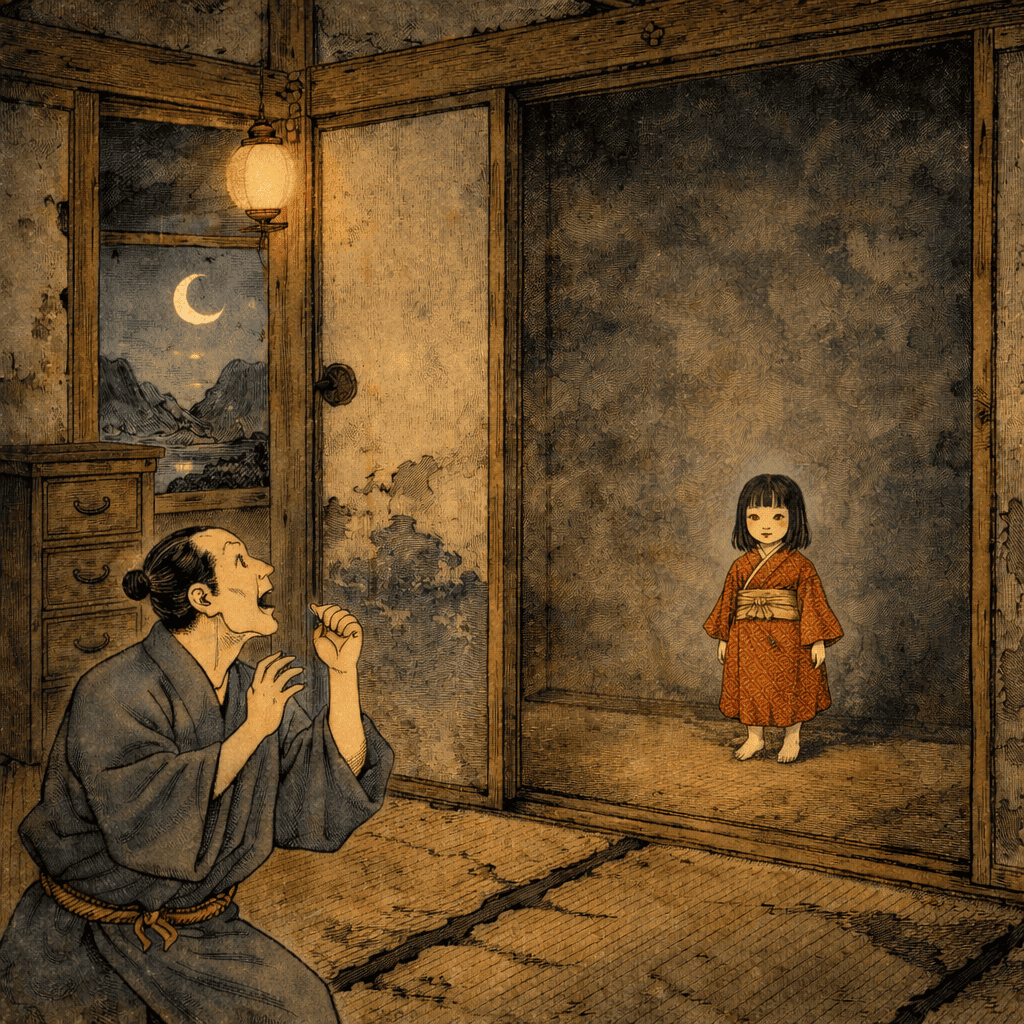
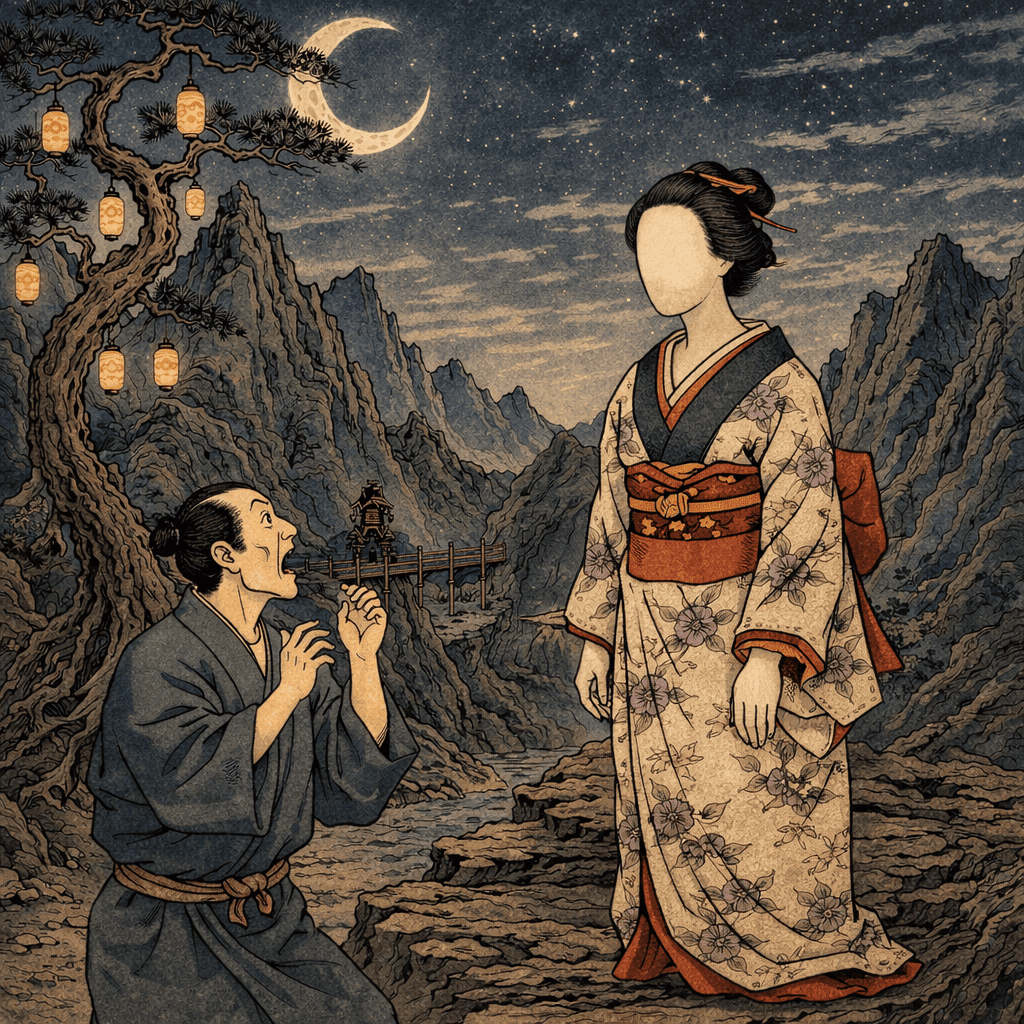
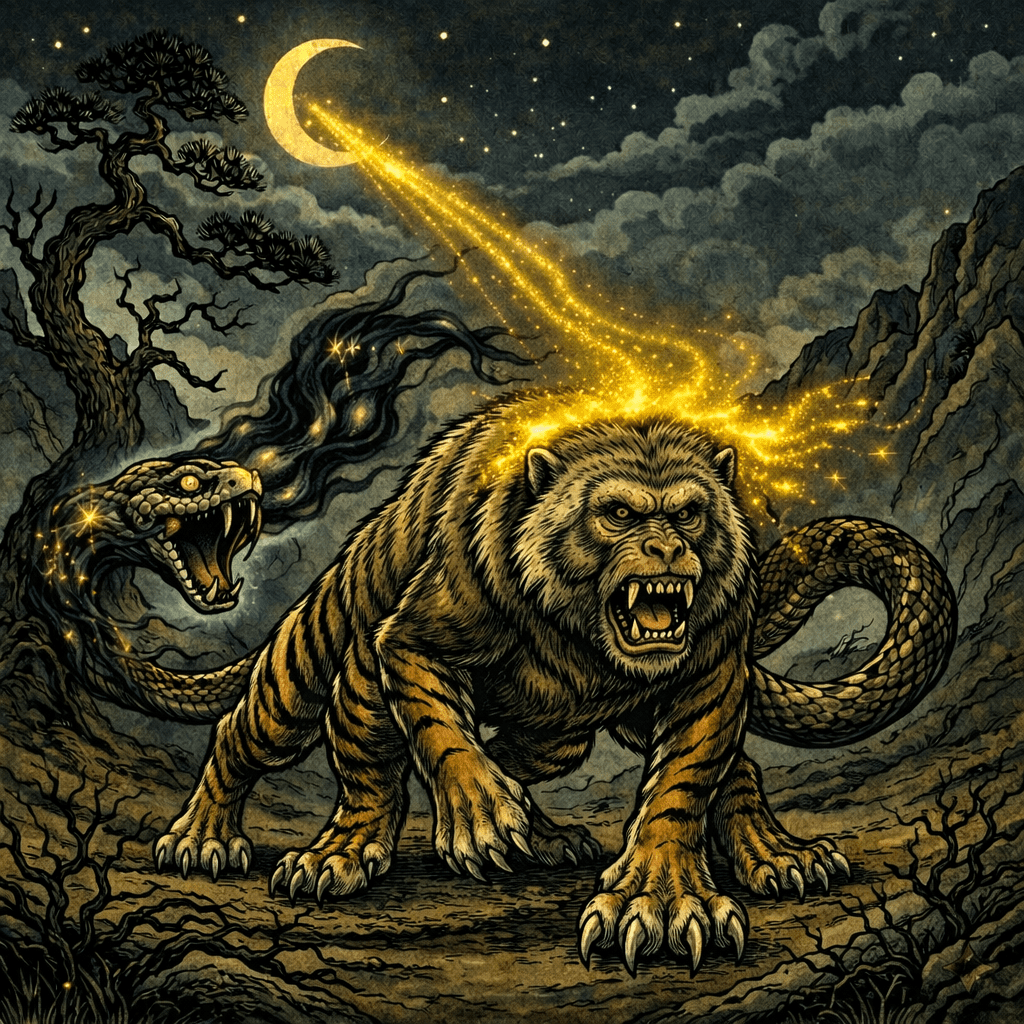
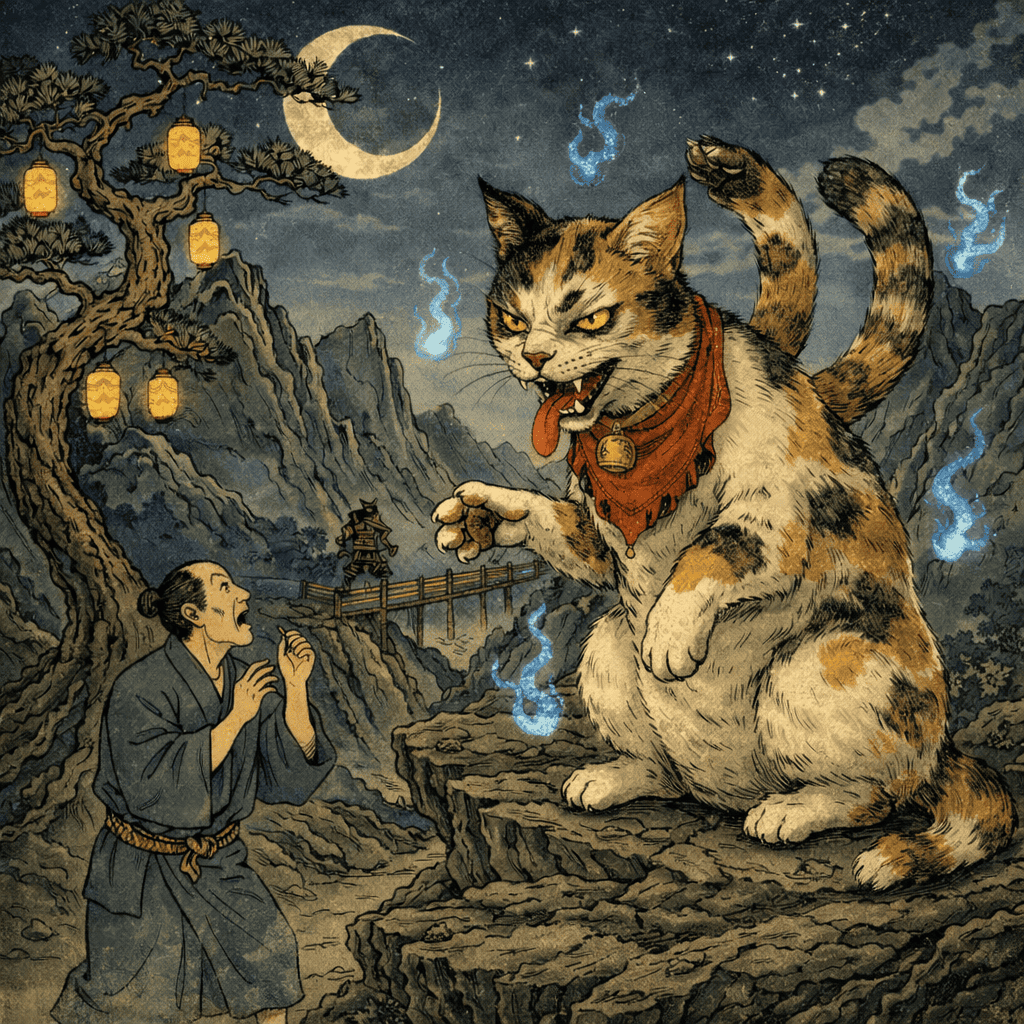
One more thing about the origin, because it is the sort of detail that rearranges how you watch the series. Mononoke is a spin-off. The Medicine Seller first appeared in the last of the three arcs of a 2006 Toei horror anthology called Ayakashi: Samurai Horror Tales, broadcast on the same noitaminA slot, in a story about a bakeneko haunting a bankrupt samurai household. He was popular enough that the studio built a whole series around him. The character came first. The show was reverse-engineered to give him somewhere to walk.
What a Hebigami Actually Is
Here is where English-language coverage of this film tends to stop, having translated the title and moved on. Hebigami, 蛇神, means snake god. That is correct and it is almost useless, because it implies there is a snake god, one of him, with a name and a biography.
There is not. Hebigami is a bucket. It holds at least four distinct things that Japanese tradition does with snakes, and they do not agree with one another.
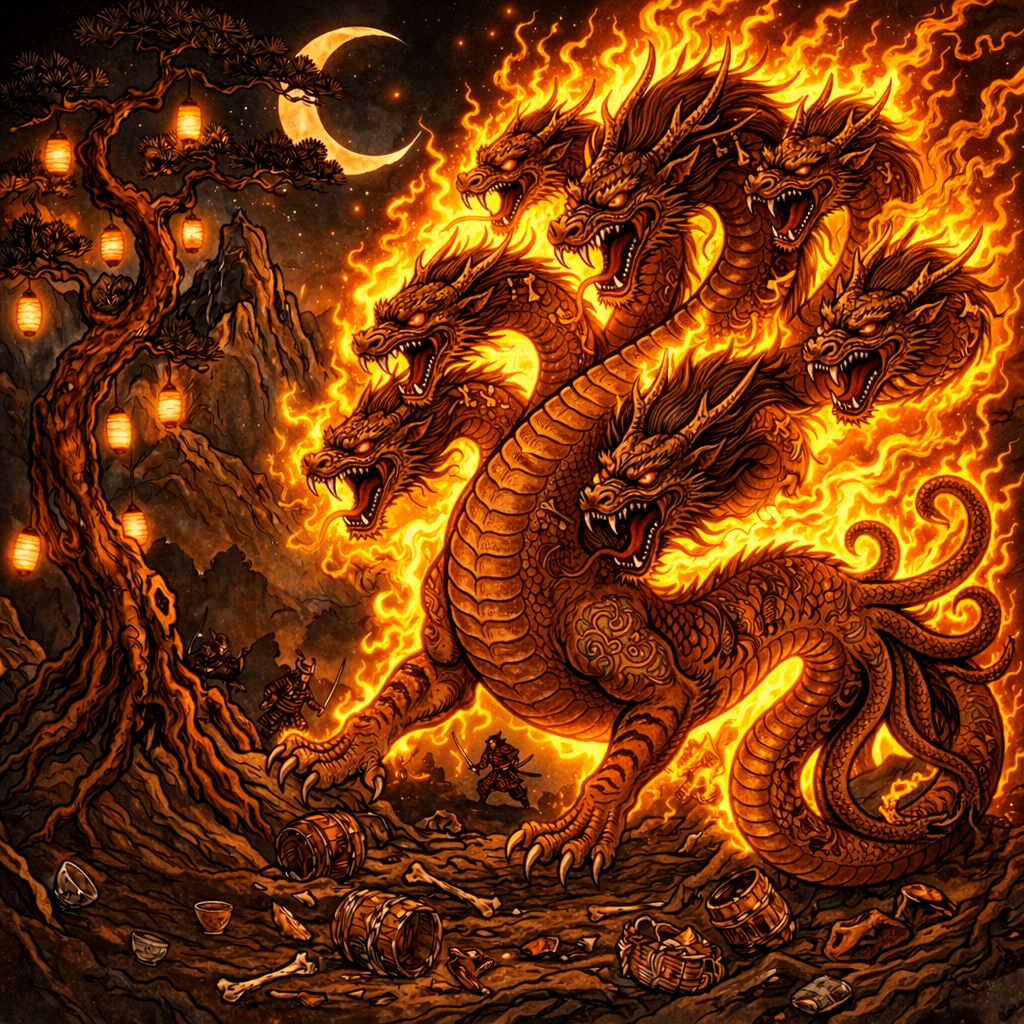
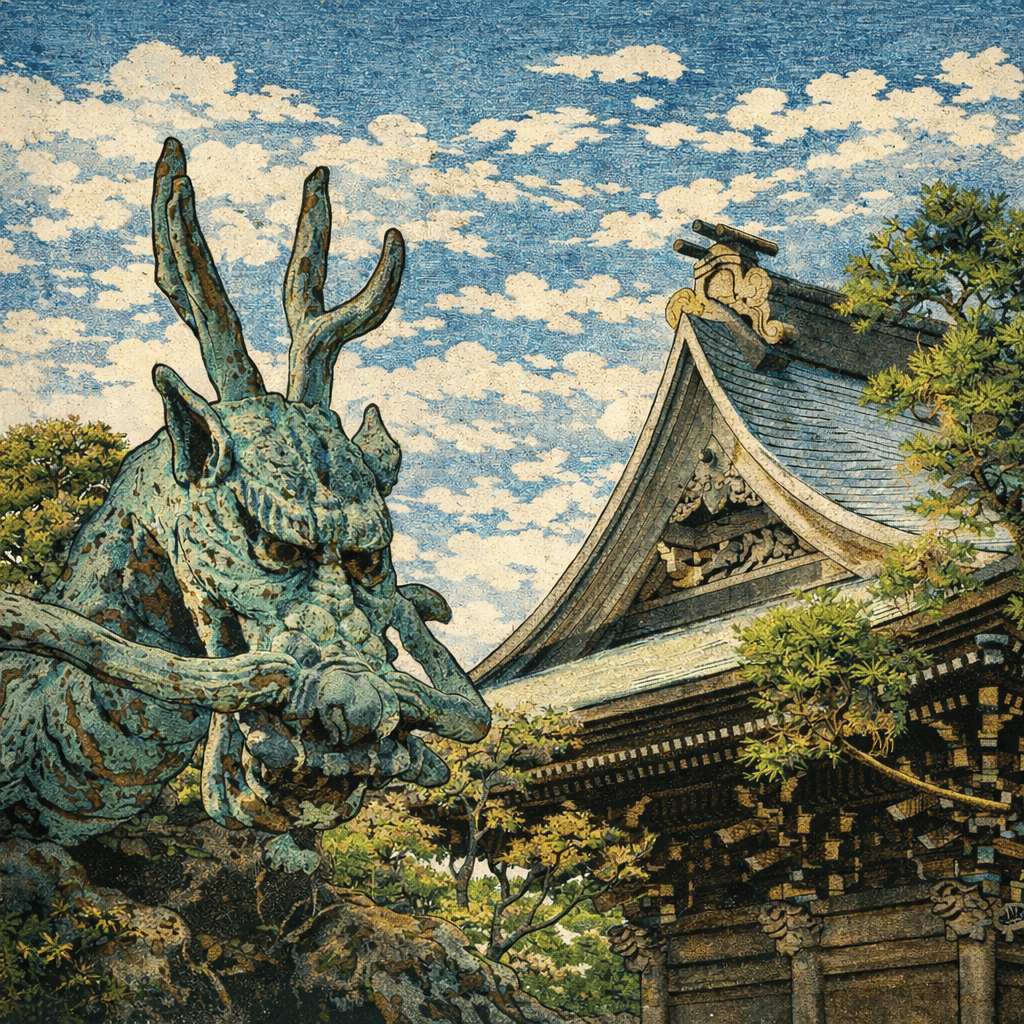
The snake as a water deity. This is the oldest and the widest layer. Snakes live in wet ground, in paddy margins, in the roots of things by rivers, and ancient belief held that the powers governing water took serpent form. Rain-making rituals were addressed to snakes. Straw serpents were and still are plaited and hung at shrines whose deity is understood to have been a snake before anyone thought to give it a human shape. Every dragon in Japan is standing on top of a snake that was there first — the imported Chinese dragon settled onto an existing native serpent-as-water-god, and the two have been difficult to separate ever since. If you want the shrines where that layer is still visible, we have mapped the dragon and serpent shrines of Japan.
The snake as the form a god takes in order to be seen. Not a symbol of the god. The god, in a body small enough to fit in a box. This is the Mount Miwa tradition, and it has a scene attached to it that is discussed in the next section.
The snake as what a person becomes. A woman’s attachment, jealousy or betrayed love hardens, scale by scale, until she is no longer a woman. This is the Kiyohime layer, and it is the one that matters most for a story set in the Ōoku.
The snake as a possession — something a household keeps. A small snake in a jar that makes a family rich and makes their enemies ill, feared and fed in equal measure. This is Tōbyō, and it is almost entirely undocumented in English.
The film uses one word. Japanese belief has four answers to it, and the interesting question is which one a given story is reaching for.
The God in the Comb Box
The single most important snake in Japanese religion is small, and the story about it is about a marriage going wrong at dawn.
The Nihon Shoki, in the chronicle of Emperor Suijin, tells it like this. Ōmononushi, the deity of Mount Miwa, took as his wife Yamato-totohi-momoso-hime, a princess who served as a medium. He came only at night and was never there in the morning. She asked to see him — just once, in daylight, so that she could look at her husband’s face. He agreed, on a condition: he would be in her comb box in the morning, and she was not to be startled by his appearance.
At dawn she opened the box. Inside was a small snake.
She screamed. The god was shamed, took human form long enough to reproach her, and went back up the mountain. She sat down in her grief, a chopstick pierced her, and she died. The chronicle says people of that time called her grave the Chopstick Tomb — Hashihaka — and that it was built by men in the day and by gods at night.
Folklorists classify a whole family of Japanese tales by this narrative, the Miwayama type: a divine or monstrous husband who visits in darkness, a woman who insists on seeing, and a revelation that cannot be walked back. It is worth noticing what the story blames. Not the snake. The god does nothing malicious; he keeps his promise exactly. The catastrophe is caused entirely by a woman looking at something in her own bedroom and reacting the way a human being reacts.
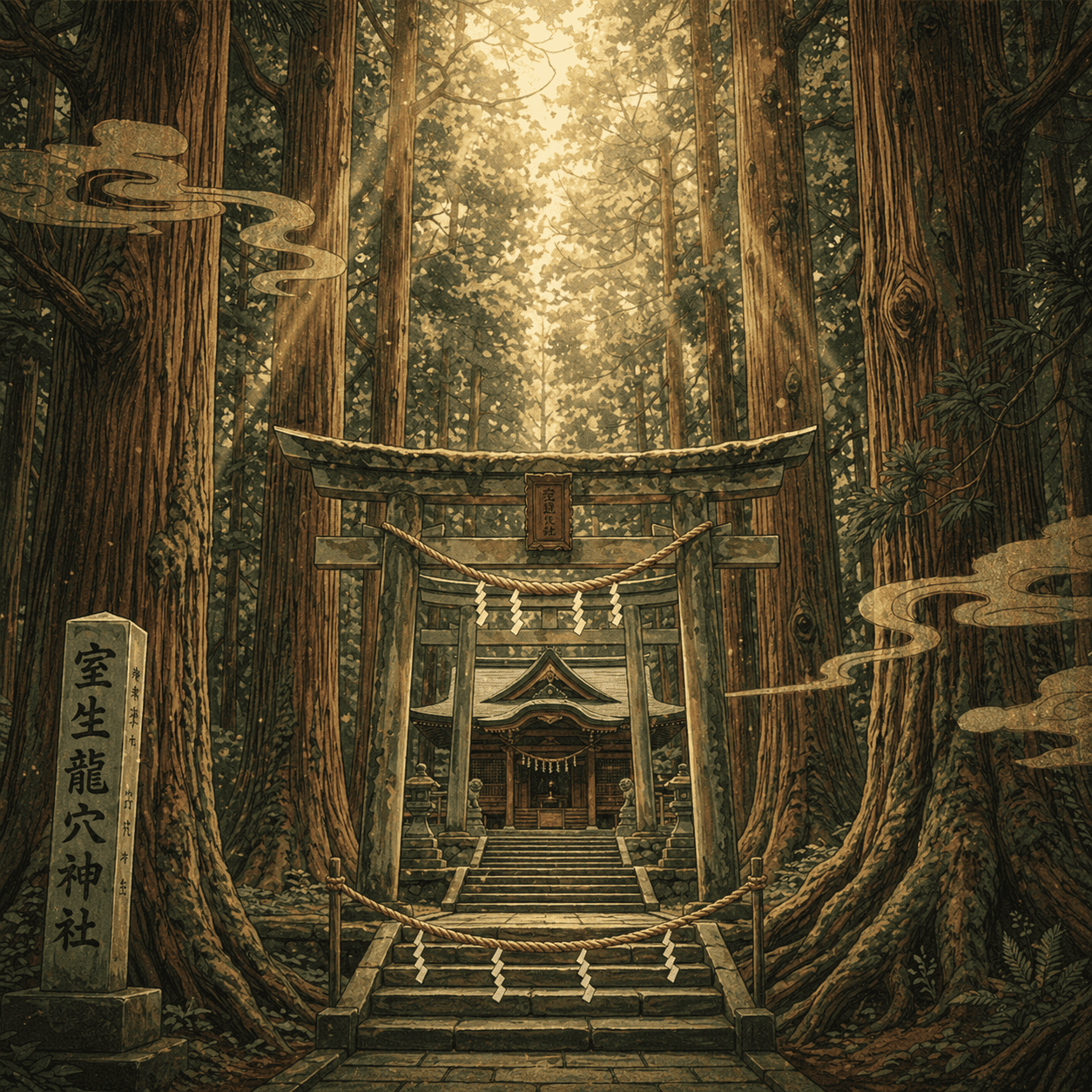
Ōmononushi is still enshrined at Ōmiwa Shrine in Sakurai, Nara, which is often described as one of the oldest shrines in Japan. It has no honden — no inner sanctuary building — because there is nothing to put in one: the mountain itself is the object of worship, and prayer is directed from the hall of worship through a triple gate called the mitsu-torii towards Mount Miwa. Inside the precinct stands a cedar called the Mi-no-Kamisugi, the Sacred Serpent Cedar. The shrine’s own explanation is direct: white snakes are seen going in and out of the hollow in its trunk, and the serpent is venerated as the incarnation of the great deity, as recorded in texts such as the Nihon Shoki. By the reckoning of the Yamato Meisho Zue of 1791, the present tree is around four hundred years old.
In front of it, worshippers leave eggs and sake, because those are what the snake — addressed affectionately as mi-san — is understood to like. This is not folklore in the past tense. Go on any day of the week and the eggs will be there.
The Woman Who Became the Serpent
The second tradition runs in the opposite direction. Instead of a god descending into a snake’s body, a human being climbs into one.
A young monk named Anchin, on pilgrimage to Kumano, lodged at the house of a local official in what is now Wakayama. The official’s daughter, Kiyohime, fell in love with him. He put her off with a promise to return on his way back, and then took another road. When she understood that he had lied, she went after him.
She caught up with him at Dōjōji. By then she was no longer a woman. He hid beneath the temple bell, which had been lowered to the ground to conceal him, and she coiled around it and burned him to death inside it, and then threw herself into the river.
The oldest versions of this, in Heian-period collections including the Konjaku Monogatarishū, do not name either of them — they are simply a monk and a widow. The name Anchin first appears in the Genkō Shakusho of 1322; Kiyohime is later still, first surfacing in a puppet play in 1742. So the characters accreted names over roughly six centuries, which is a useful reminder of how these things are actually built.
The detail that matters most is a change made in the Muromachi period. In the illustrated handscroll Dōjōji Engi, now an Important Cultural Property, the transformation is depicted for the first time as gradual — happening to her as she runs, over the course of the chase, rather than all at once. That is the invention that gave the legend its grip, and it is the reason the story became the basis of an entire genre of the performing arts, the Dōjōji mono, which passed from Noh into kabuki and the puppet theatre and is still performed.
Read that structure again next to the rule the Medicine Seller works under. A monster with a Form, a Truth — a jilted woman on a road in Wakayama — and a Reason. Kiyohime is a mononoke with all three boxes ticked, four hundred years before the word was attached to a cartoon. When a Japanese story puts a serpent in a building full of women, it is not reaching for a random animal. It is reaching for this.
The Snake Kept in a Jar
This section exists because we could not find it written anywhere in English, and it is the strangest thing in the file.
In the Chūgoku and Shikoku regions of western Japan there is a kind of possessing spirit called Tōbyō. It is described as a small black snake, around ten to twenty centimetres long, with a gold ring around its neck. It is kept — the word people use is kept, as with livestock — in a jar. In Kagawa the same thing is called Tonbogami.
A household said to have Tōbyō is a tōbyō-mochi, a Tōbyō holder. Such families were believed to become conspicuously wealthy, because the snake goes out at night and brings back what belongs to other people. They were also believed to be able to set it on their enemies, who would suffer violent pain in every joint. Being known as a Tōbyō household was not a compliment. It was an accusation, and it had consequences that can be counted. The folklorist Takatoshi Ishizuka (1918–2014), who spent years collecting these beliefs in rural Shimane, Kochi and Oita, approached the question through marriage records, and found that in districts where possession beliefs ran strong the marriage prospects of labelled households measurably narrowed. That is the part of this subject that is not folklore at all. Somebody’s grandmother did not marry the person she wanted to marry, because of a snake that nobody ever saw. The collected local reports are held in the folklore database of the International Research Center for Japanese Studies.
And then the belief does something remarkable, which is that it turns into a shrine.
In Kasaoka, in Okayama Prefecture, stands Dōtsū Shrine, where the same entity is enshrined under the honorific name Dōtsū-sama — and where it is white rather than black. The shrine’s own account of its founding runs like this. In the Tenshō era, between 1573 and 1592, a fisherman of Yokoshima named Isobei cast his net offshore, and three times out of three the net came up holding the same stone. He enshrined that stone in a valley called Dōtsū-dani at Ōiso in Kasaoka. Later, during the wars, the little shrine fell into ruin, and the district was struck by epidemic and by one disaster after another, and word went round that this was the curse of Dōtsū-sama. Believers carried the sacred object to Yokoshima, built a hall for it and resumed the rites, and the sickness and the disasters stopped.
What stands there now is one of the more startling sights in Japanese religion: rows of small donated wooden houses, given by believers, each containing a pair of white snake figures coiled around a post with their mouths open and closed in the a-un pairing used for guardian statues — and eggs set out in front of them.
So the arc is complete. A thing that once narrowed a family’s marriage prospects is now a shrine that Okayama Prefecture’s own tourism office recommends visiting. The snake that ruined families is fed eggs by them. That movement — from the feared to the venerated, without either feeling cancelling the other out — is close to the centre of how Japanese religion actually works, and it is the single hardest thing to convey to an audience that has been taught to sort supernatural beings into good and evil.
The Snake with an Old Man’s Head
One more, because it is the version most visitors to Japan have already seen without being told what they were looking at.
Ugajin is depicted as a coiled white snake with the head of an old man. The fusion is old — it begins in the late Heian period, around the twelfth century, and is thoroughly established by the Kamakura period — and it comes from Japan’s native serpent and harvest-deity beliefs meeting the imported cult of Benzaiten, who arrives from India as Sarasvati and who is herself already associated with water and with nāga, the serpent guardians of Indian tradition.
The result is Uga-Benzaiten: the goddess with a small snake-bodied, white-scaled, old-man-headed deity seated on her head. Once you know to look for it you will find it everywhere, on statues and on hanging scrolls, and a well-known example survives at Enoshima Shrine in Kanagawa. The white snake as Benzaiten’s messenger, and the association of white snakes with luck and money, comes down this line.
If you have ever watched people in Kamakura washing banknotes in a cave and wondered what the ceremony was, this is what it was. The shrine is Zeniarai Benzaiten Ugafuku Shrine, and its name says the whole thing out loud: Ugafuku is Ugajin. Its founding legend holds that in 1185, on the Day of the Snake in the Month of the Snake in the Year of the Snake, a water deity with a human head and a serpent’s body appeared to Minamoto no Yoritomo in a dream and told him to draw the water that springs there. The practice of washing money in it is credited to Hōjō Tokiyori, who is said to have told people to come and do it on the Day of the Snake. The banknote is downstream of a serpent, and the calendar says so three times over.
Why a Serpent, and Why the Ōoku
We need to be careful here, so let us be explicit about the line. Nobody involved in making these films has said that the hebigami is based on any particular legend, shrine or text. No such statement exists as far as we can find, and nothing that follows should be read as one. What follows is about the room.
All three films are set in the Ōoku, the inner chambers of Edo Castle: the quarters where the women who served the shogun lived. The place was established under the second shogun, Hidetada, and formalised in its organisation under the third, Iemitsu; the name Ōoku itself came into use around the time of the fourth, Ietsuna. At its height it is said to have housed several thousand women. Its boundary was marked by copper-plated walls, and it was reachable by exactly two passages, the osuzu-rōka or bell corridors. Adult men were forbidden to enter without the shogun.
A sealed building, a fixed population, a rigid hierarchy, no exit, and one man. Everything that happens inside it has to happen inside it. Ambition cannot be spent anywhere, rivalry cannot be resolved anywhere, and love has precisely one possible object and several thousand competitors for it.
Now recall what the Japanese serpent tradition is for. In the Miwa story, a woman’s uncontainable reaction to what she has seen destroys her. In the Dōjōji story, a woman’s uncontainable attachment converts her, gradually and irreversibly, into a snake. In the Tōbyō belief, a household’s envy of another household’s wealth is explained by a snake in a jar. In all three, the serpent is the shape that a feeling takes when it has been sealed in and has nowhere to go.
That is not a claim about the screenplay. It is a claim about the vocabulary, and it is the reason the choice of animal is legible to a Japanese audience in a way it is not to an English-speaking one. The Ghibli-trained instinct is to read a giant snake as a nature spirit defending a forest. The tradition this film is written inside reads it as somebody’s feeling, kept too long in a closed room.
Where You Can Actually Go
Four of the places in this article are ordinary destinations that you can put on an itinerary.
Ōmiwa Shrine (大神神社), Sakurai, Nara. The Mi-no-Kamisugi stands within the precinct and needs no ticket, no appointment and no ceremony; the eggs will be there when you arrive. The nearest station is JR Miwa on the Man’yō Mahoroba line — the Sakurai line — about five minutes’ walk from the second torii. It sits on the Yamanobe-no-michi walking route, and it pairs naturally with a day in Nara.
Dōtsū Shrine (道通神社), Kasaoka, Okayama. The snake houses are the reason to go. Kasaoka is on the JR San’yō main line between Fukuyama and Kurashiki, and the shrine is out towards the reclaimed land at Yokoshima, which realistically means a car or a taxi from the station. This one is genuinely off the English-language map — we found no substantial English account of it while researching this article.
Dōjōji (道成寺), Hidakagawa, Wakayama. The temple where the bell came down. It is an eight-minute walk from Dōjōji station on the JR Kisei main line, and the thing to go for is the e-toki seppō — a narrated picture-scroll sermon in which one of the temple’s own priests unrolls a copy of the Dōjōji Engi and tells the story from the pictures. The temple performs it around six times a day, between 9am and 4pm, and no reservation is needed.
Enoshima Shrine (江島神社), Fujisawa, Kanagawa. The easiest of the four from Tokyo, and the place to see Uga-Benzaiten.
Ordinary shrine conduct applies at all of them, and one thing beyond it: at Ōmiwa and at Dōtsū, the snakes are not a theme. Do not go looking for a live one, do not put anything into the hollow of the cedar, and leave the offerings other people have left exactly where they are.


Frequently Asked Questions
What is a hebigami?
Hebigami (蛇神) means, literally, snake god. It is not the name of one creature. It is a category, and a very large one: across Japan, snakes have been treated as water deities, as rain-bringers, as the visible form a kami takes when it chooses to be seen, as messengers of Benzaiten, as guardians of household wealth, and as the thing a human being turns into when an emotion has nowhere else to go. Ōmononushi of Mount Miwa appears in the Nihon Shoki as a small snake in a comb box. Kiyohime of the Dōjōji legend becomes a serpent out of betrayed love. Tōbyō in western Japan is a small snake kept in a jar that makes a household rich and its enemies ill. All of these are hebigami in the broad sense, and they have very little in common except the animal.
Is the snake god in Mononoke based on a real legend?
No source says so, and we are not going to pretend otherwise. Neither the production nor Kenji Nakamura, the trilogy’s general director, has identified a specific legend, shrine or text as the model for the film’s hebigami. What can be said accurately is that the film uses a word with a long and well-documented history in Japanese religion, and that an Edo-period audience hearing the word hebigami in the Ōoku would have brought a specific set of associations to it. This article is about those associations. It is not a claim about the screenplay.
Do I need to watch the 2007 series before the films?
No, but it is a good idea, and it is free of obstacles: the twelve-episode 2007 series streams on Netflix alongside the films, as well as on Crunchyroll and several other services. The films are a separate story with a different Medicine Seller, set in the Ōoku of Edo Castle, and they are designed to be entered cold. What the series gives you is the method — the rule that the Medicine Seller cannot draw his sword until he knows the mononoke’s Form, its Truth and its Reason — and once you have watched someone fail to name a thing for forty minutes, the films play very differently.
Why do people leave eggs at Japanese shrines?
Because at shrines associated with snake deities, eggs are what the snake is understood to like. At Ōmiwa Shrine in Nara, worshippers leave eggs and sake at the foot of a sacred cedar called the Mi-no-Kamisugi, where white snakes are said to go in and out of the hollow in the trunk; the shrine’s own explanation is that the snake — addressed affectionately as mi-san — is the visible form of the enshrined deity Ōmononushi. At Dōtsū Shrine in Okayama the same logic produces a stranger sight: rows of small wooden houses donated by believers, each holding a pair of white snake figures, with eggs set in front of them.
Conclusion
A god small enough to fit in a comb box. A woman who became a snake on a road in Wakayama and is still becoming one, nightly, on stages across Japan. A black snake in a jar that made your neighbours rich and your joints hurt, which is now a white snake in a wooden house with an egg in front of it. A goddess with an old man’s face coiled on her head.
None of these is the hebigami, and the film is not obliged to be any of them. But a Japanese viewer walks into that cinema already carrying all four, the way an English-speaking viewer walks into a film about a wolf carrying several centuries of wolves. That cargo is most of what gets lost between one language and another, and recovering a little of it is the entire purpose of this site.
Chapter III reaches Netflix on 29 September. If you have the time before then, the 2007 series is on the same service, and it is twelve episodes. Watch the Medicine Seller fail to name something. Then watch him walk into a corridor full of women who have not been outside in years, and see what he finds coiled at the end of it.
For more on the serpent side of Japanese belief, start with Yamata no Orochi, or browse the full Yokai Files and Pop Culture archives.
This is The Yokai Files.
Sources
Every factual claim above comes from one of the following. Where a point could not be verified, we have said so in the text rather than filling the gap.
- Ōmiwa Shrine, official precinct guide, Mi-no-Kamisugi (Japanese). The source for the white snakes in the hollow, the serpent as the incarnation of Ōmononushi, the offerings of eggs and sake, the name mi-san, and the four-hundred-year estimate from the Yamato Meisho Zue of 1791. oomiwa.or.jp/keidaimap/04-minokamisugi/
- Okayama Prefecture Shrine Agency, entry for Dōtsū Shrine (Japanese). The source for the founding account, the fisherman Isobei, the three casts of the net, the Tenshō-era date and the move to Yokoshima. okayama-jinjacho.or.jp/search/18221/
- International Research Center for Japanese Studies, Database of Strange Phenomena and Yōkai Folklore (Japanese). The source for the Tōbyō and Kuchinawa records. nichibun.ac.jp/YoukaiDB3/
- Nihon Daihyakka Zensho and Seisen-ban Nihon Kokugo Daijiten, entries for Tōbyō, via Kotobank (Japanese). The source for the size and gold neck-ring of the snake, the jar, the Kagawa name Tonbogami, and the beliefs about wealth and joint pain. kotobank.jp/word/とうびょう
- Kotobank and Weblio, dictionary entries for mononoke 物の怪 (Japanese). The source for the Nihon Kōki attestation of 830 CE, the wording of that entry, and the derivation of the word from mono plus ke in the sense of sickness. kotobank.jp/word/物の怪
- Nihon Shoki, chronicle of Emperor Suijin, for the marriage of Ōmononushi and Yamato-totohi-momoso-hime, the comb box, the small snake and the Hashihaka tomb. Consulted in modern Japanese summary and transcription rather than in the original manuscript. seisaku.bz/nihonshoki/shoki_05.html
- Dōjōji, official temple site (Japanese), and the Wakayama Prefecture cultural history project, for the Anchin and Kiyohime narrative, the Dōjōji Engi handscroll, and the development of the Dōjōji mono genre. dojoji.com/anchin/ · wakayama-rekishi100.jp/story/042.html
- Ōmiwa Shrine, official access pages (Japanese). The source for the absence of a honden, worship through the mitsu-torii towards the mountain, and the five-minute walk from JR Miwa station on the Man’yō Mahoroba line. oomiwa.or.jp/access/station/
- Wakayama Prefecture official tourism site, entry for Dōjōji (Japanese). The source for the eight-minute walk from Dōjōji station and for the e-toki seppō, including the use of a copy of the Dōjōji Engi and the daily schedule. wakayama-kanko.or.jp/spots/detail_312.html
- Nippon.com, “Serpent Tales: Snakes in Japanese Mythology and Folklore” (English and Japanese editions), for the snake as water deity, the rain-making rituals and the relationship between native serpent belief and the imported dragon. nippon.com/en/japan-topics/b09806/
- Japanese folklore scholarship on tsukimono-suji, possession held to run in family lines, summarising the fieldwork of Takatoshi Ishizuka (1918–2014) in Shimane, Kochi and Oita. The source for the use of marriage records to measure the narrowing of marriage prospects for labelled households. 憑きもの筋 — overview and bibliography
- Okayama Prefecture official tourism site, feature on Dōtsū Shrine (Japanese). The source for the shrine being publicly promoted as a destination, and for the description of the donated snake houses and the eggs. okayama-kanko.jp/okatabi/1449/page
- Kanagawa Prefecture official tourism site, entry for Zeniarai Benzaiten Ugafuku Shrine (Japanese). The source for the full name, the human-headed serpent water deity, the 1185 founding legend on the Day of the Snake, and the attribution of the money-washing practice to Hōjō Tokiyori. kanagawa-kankou.or.jp/spot/155
- Nippon.com, “Kasuga no Tsubone and the Establishment of the Shōgun’s Inner Chambers” (English), for the founding of the Ōoku under Hidetada, its formalisation under Iemitsu, the adoption of the name under Ietsuna, the copper-plated walls and the two bell corridors. nippon.com/en/japan-topics/c10801/
- Anime News Network, news reports of 10 December 2025, 18 August 2026 and 8 August 2025, and 映画ナタリー, for the Japanese and English titles, the theatrical and Netflix dates, the staff and cast of Chapter III, and the Fantasia awards. animenewsnetwork.com — Netflix date · natalie.mu/eiga/film/199048
- KAI-YOU and 映画ナタリー, July and August 2026, for the announcement of the new project and the third Medicine Seller, Ken, together with the three Kadokawa novels. kai-you.net/article/96295
A note on what we could not confirm. We have not seen the original manuscript pages of the Nihon Kōki or the Nihon Shoki entries quoted here; both are given as they are transcribed in standard Japanese reference works. We have also found no statement from the production identifying a model for the film’s hebigami, and we make no such claim.
The illustration at the top of this article was made for it. It is not a frame from the film, and it does not depict any existing building or shrine.
Support The Yokai Files
Enjoyed this deep dive into Japanese folklore?
The Yokai Files is reader-supported. Your support helps us research deeper, write more, and keep the darkness alive.